

Dr. David Klurfeld—longtime USDA scientist and one of the few insiders to publicly challenge the WHO’s classification of red meat as a carcinogen. We go deep into the flawed evidence behind the infamous 2015 IARC report, why nutritional epidemiology often fails to prove causality, and how a small group of researchers helped shape global policy with low-quality science. If you’ve ever felt confused about meat, saturated fat, or dietary guidelines, this conversation will help you think critically about what “counts” as evidence—and who gets to decide.
We cover:
- Dr. Klurfeld’s personal journey and lessons from a career in public health
- Why the 2015 IARC red meat classification was based on weak and inconsistent evidence
- How observational studies and “allegiance bias” mislead nutrition science
- The politics of dietary guidelines and the role of the USDA and WHO
- What the media got wrong—and why red meat remains a nutrient-dense food
Whether you’re a clinician, dietitian, or simply trying to make better nutrition decisions, this episode is a powerful reminder that bias, groupthink and weak data can distort science and mislead the public. We need to be discerning about the nutrition and health advice we follow.
Who is Dr. David Klurfeld?
Dr. David Klurfeld is a nutritional scientist and former National Program Leader for Human Nutrition at the USDA’s Agricultural Research Service. He also served as Professor and Chair of Nutrition and Food Science at Wayne State University and Associate Editor of The American Journal of Clinical Nutrition. He has authored more than 200 scientific publications and was one of 22 experts invited to the 2015 IARC working group on red meat and cancer. He is a longtime advocate for scientific integrity in public health policy.
Timestamps
- 00:00 – Dr. Gabrielle Lyon introduces Dr. David Klurfeld and the controversy around red meat and cancer.
- 03:18 – Dr. Klurfeld explains his unconventional path into nutrition science and his early influences.
- 06:07 – He describes how “allegiance bias” distorts nutrition research outcomes.
- 09:08 – Klurfeld calls the IARC red meat classification “the most frustrating professional experience of my life.”
- 12:15 – He explains why epidemiology and food questionnaires are unreliable for determining dietary risk.
- 15:30 – Red meat is misleadingly grouped with engine exhaust and radiation in cancer risk categories.
- 22:15 – Many IARC scientists had pre-existing biases and used the panel to reinforce prior publications.
- 26:08 – Klurfeld critiques the misuse of correlation in nutrition
- 32:06 – He debunks the commonly cited 17% increase in colorectal cancer risk from red meat.
- 48:44 – Activist groups filed FOIA requests to access years of Klurfeld’s emails during public-private research.
- 1:09:21 – He explains why nitrogen content alone is an inadequate way to assess protein quality.
summerizer
Opening thesis
- The red-meat cancer story needs separation from headlines, ideology, and weak causal thinking.
- Klurfeld’s view is that unprocessed red meat has not been shown to be an identifiable cancer risk.
- Processed meat and unprocessed red meat received handling that created public fear without enough attention to magnitude, mechanism, or uncertainty.
- The most durable nutrition advice in the talk is moderation, variety, and reluctance to change behavior from a single study.
Scientific background and habits of mind
- Klurfeld came from agriculture, pathology, and decades of animal and human nutrition research.
- Early alarmist food books influenced him when young, but later he judged much of that material as fear-driven.
- Work with David Kritchevsky taught him to respect careful experimentation, humility, and people outside elite institutions.
- In nutrition, one study should almost never change behavior, because isolated findings are too easy to overread.
- Allegiance bias is common; once the investigator is known, the conclusion is often predictable.
- Human nutrition papers sometimes look too clean compared with animal experiments, which makes Klurfeld wary of their precision.
- Nutrition fights are not new; they are simply more visible now.
IARC red-meat and processed-meat review
- The IARC red-meat working group was one of the most frustrating professional experiences of Klurfeld’s career.
- IARC is a WHO cancer agency that evaluates hazards, not ordinary-life absolute risk.
- The working group had twenty-two scientists, with epidemiologists exerting major influence.
- The IARC process was not a systematic review and did not run a formal meta-analysis inside the meeting.
- Staff prepared large evidence documents, then the group voted on carcinogenic-hazard categories.
- Risk assessors and risk managers are usually separated in government, but the IARC vote blurred that line.
- Klurfeld could have accepted a cautious finding that more research was needed, but not a causal conclusion from that evidence base.
- Nutritional epidemiology used for diet-cancer questions is weaker than the standards normally used for causal proof.
Why the causal case against red meat looked weak
- Most of the case rested on observational associations, not controlled experiments showing that red meat causes cancer.
- Food-frequency data often measure diet once or a few times and then assume it represents decades of intake.
- When many foods, nutrients, and disease endpoints are tested, chance findings become easy to generate.
- A database with dozens of foods, dozens of nutrients, and many endpoints can produce thousands of nominally significant results by chance.
- Spurious examples such as margarine or cheese correlations with divorce show why association is not causation.
- Meat eaters and low-meat eaters differ in smoking, exercise, weight, education, health behavior, and other factors that models cannot fully fix.
- Statistical swaps between meat and plant foods are not the same as real people changing food patterns under controlled conditions.
Animal and mechanism evidence
- Klurfeld’s rat studies did not show meat increasing colon-cancer risk.
- Some mechanism work used calcium-deficient rat models and blood sausage, which do not resemble ordinary roast beef consumption.
- Bacon in a chemically induced rat model reduced precancerous lesions in one study, which complicates a simple processed-meat story.
- Calcium deficiency was a major issue in some rodent work, so the meat effect could not be cleanly separated from the mineral context.
- Mechanistic work around heme iron and nitroso compounds did not become clear human proof.
- The animal evidence did not give the strong biological proof needed to turn weak associations into causation.
Human cohort findings and confounding
- The 2012 Harvard cohort paper linked red meat with higher mortality and modeled lower mortality when other protein foods were swapped in.
- Klurfeld sees those modeled swaps as statistical constructs, not proof that changing one food will create the predicted outcome.
- The EPIC and meta-analysis estimates around colorectal cancer produced small relative risks, including the commonly cited 17% per 100 grams.
- Small relative risks in nutritional epidemiology are especially vulnerable to residual confounding and measurement error.
- A later dose-response pattern looked biologically weak when high-red-meat groups had similar risks despite very different intake levels.
- The NIH-AARP study linked red meat with heart disease, cancer, total mortality, accidents, and other causes of death.
- If roast beef seems linked with fatal accidents, that is a warning sign for uncontrolled lifestyle confounding.
- White meat looking protective for almost everything in the same dataset strengthens the concern that broad behavior patterns are driving results.
Conflicts, ideology, and committees
- Financial conflicts matter, but intellectual and dietary commitments can matter too.
- Vegetarians on a meat-cancer panel should disclose that commitment just as industry-linked scientists disclose funding.
- Klurfeld did not see an explicit agenda, but he did see people who had built careers on meat-cancer associations evaluating their own area.
- Nutrition committees can become echo chambers when the same people, assumptions, and methods recur across panels.
- Public-health language often turns weak evidence into simple warnings that the public hears as certainty.
IARC bias and process problems
- The IARC red-meat panel was the most frustrating professional experience of my life.
- IARC evaluates cancer hazards, not real-world absolute risk, so its categories can make weak food-risk evidence sound much stronger than it is.
- The working group had 22 self-nominated scientists from 10 countries, but 11 were epidemiologists, so observational methods dominated the process.
- The review was not a systematic review, and IARC staff did not run a formal meta-analysis during the meeting, even though epidemiology drove the final decision.
- The animal evidence was mixed, with some studies showing increase, no change, or decrease, so it contributed almost nothing to the decision.
- The mechanistic evidence showed possible pathways, not mechanisms clearly demonstrated in people eating meat.
- A “possible risk” conclusion for processed meat would have been acceptable, but the conclusion that unprocessed red meat had an identifiable cancer risk was not supported.
- The red-meat conclusion was based exclusively on epidemiology, and nutritional epidemiology does not deserve that level of respect for causal conclusions.
- The Lancet Oncology summary said 800 studies were examined, but only 18 were used; roughly 780 were discarded for not showing anything, not showing the desired result, or other reasons.
- The final monograph was supposed to appear within six months, but took almost three years, and working-group members did not see it before publication.
- The epidemiologists worked separately, reached their own conclusions, and the rest of the committee was effectively expected to accept them.
- Many epidemiologists on the panel were friends, had served on previous IARC committees, and had already published work linking red or processed meat with colon-cancer risk.
- The process gave them an opportunity to reinforce the importance of their own work, even though there was no explicit “we’re going to nail red meat” agenda.
- I entered skeptical of the meat-cancer relationship, but the evidence looked even softer after review, and I could not conclude that either red meat or processed meat caused any examined disease endpoint.
- The evidence has become weaker with time, not stronger.
- A number of committee members were vegetarians, and vegetarianism on a meat-cancer panel is an intellectual conflict of interest that should be disclosed.
- After the WHO head of nutrition told me she was vegetarian, I watched what members ate and estimated that at least half, probably two-thirds, were vegetarian.
- IARC’s hazard categories also create public confusion because red meat ends up near examples such as smoking, radiation, alcohol, DDT, engine exhaust, and lead, without proper risk perspective.
- IARC formerly had a category 4 for “not carcinogenic,” but after roughly a thousand reviews only one chemical received it, and the category was later eliminated.
- That reflects the deeper problem: once IARC investigates something, it is effectively treated as guilty unless not proven.
- Coffee shows the same pattern: it was treated as a probable carcinogen, then reassessed after years of criticism, while California Prop 65 warnings amplified public confusion.
Dietary Guidelines and federal nutrition work
- USDA and HHS dietary guidelines are written by small government offices and committees, not by the whole nutrition-research enterprise.
- Klurfeld’s USDA role involved overseeing human nutrition research centers, not personally writing the Dietary Guidelines for Americans.
- The USDA centers included inpatient facilities and long-term research planning across many scientists and topics.
- The public follows dietary guidelines poorly, but the food industry follows them closely because products and school meals are built around them.
- Low-fat guidance reshaped food products, but low-fat cookies and reformulated snacks were never automatically healthy foods.
- The 10% saturated-fat target traces back to rough expert judgment, not a precise biological threshold.
- The broad dietary-guideline message has changed less than the page count: reduce salt, sugar, fat, and saturated fat, and eat more fruits and vegetables.
- Klurfeld would prefer guideline conclusions to carry explicit strength-of-evidence grades.
Protein, meat, and nutrient density
- The idea that everyone eats too much protein is too broad.
- RDAs are minimum estimates from nitrogen balance, not optimal targets for aging, exercise, growth, or metabolic resilience.
- Young men may exceed minimum protein needs, while older adults, active people, children, and some women may need more attention to protein quality.
- Animal protein and plant protein are not nutritionally identical just because nitrogen content can be converted to ounce equivalents.
- Meat supplies highly bioavailable iron, zinc, vitamin B12, selenium, and other nutrients that can be harder to obtain from plant-only patterns.
- Young women are a key risk group for iron and calcium shortfalls, especially when red meat intake falls.
- Vegetarian diets can be healthy when carefully planned by knowledgeable people.
- Plant-based meat analogs may require larger portions or additional planning to match animal-source amino acids and micronutrients.
NHANES and dietary measurement limits
- NHANES is the best national dietary snapshot available, but it is still a snapshot.
- It uses about five thousand people and two twenty-four-hour recalls, which is useful for population averages.
- Two recalls are not enough to know an individual’s usual intake with high precision.
- Older USDA work found that many repeated recalls may be needed for individual nutrient estimates.
- NHANES is useful for estimating group distributions and identifying subgroups at nutrient risk.
- NHANES is often overused when people try to make conclusions beyond what two recalls can support.
Women’s Health Initiative and controlled trials
- The Women’s Health Initiative low-fat trial was enormous and expensive, with roughly twenty thousand women in the intervention and thirty thousand controls.
- After about nine years, the low-fat pattern did not reduce colon-cancer risk.
- The intervention also cut meat intake substantially, which makes it relevant to the red-meat issue even if it was not designed as a red-meat trial.
- Dismissing WHI because it was not designed specifically around red meat is inconsistent when many observational meat papers were also not designed around red meat.
- Long-term randomized diet trials are rare because they are expensive, difficult, and slow.
The beef matrix and whole-food context
- Beef should be studied as a whole food, not as isolated saturated fat, heme iron, or single nutrients.
- Beef tallow is not beef, just as butter is not the same as milk with its fat-globule membrane.
- Muscle, connective tissue, fat, cell membranes, minerals, and bioactive compounds create a matrix that can alter biological effects.
- Beef, pork, poultry, and plant foods differ in heme iron, amino acids, micronutrients, and bioactives.
- Creatine, carnosine, anserine, and other compounds may matter even when they are not classed as essential nutrients.
- Food categories that look interchangeable in guidelines may not be metabolically interchangeable.
Microbiome, biomarkers, and future nutrition science
- Nutrition needs better intermediate biomarkers, especially for cancer.
- Serum cholesterol became a major endpoint partly because it was measurable, not because it captured every health outcome.
- Cancer lacks many accepted intermediate markers; colon polyps are one of the few markers used clinically.
- CRP is too nonspecific to answer many diet questions cleanly.
- The microbiome adds another layer because intestinal bacteria produce compounds that enter human metabolism.
- Stool tests mostly show which organisms are in stool, not what is happening across the small intestine, large intestine, and metabolic networks.
- Future progress depends on better biomarkers, better causal methods, and more humility about what nutrition studies can prove.
Career and public communication
- Being a naysayer made Klurfeld less popular with some institutions, but skepticism is necessary in nutrition.
- He was not invited back by some groups after saying the diet-heart story was more complicated than they wanted.
- He is not active on social media and does not enjoy public fighting.
- The central message is that red-meat fear has outrun the quality of the evidence, and nutrition advice should be proportional to what the evidence can actually show.
References
- [00:08] Carcinogenicity of Consumption of Red and Processed Meat — https://doi.org/10.1016/S1470-2045(15)00444-1
- [00:23] Effect of Meat (Beef, Chicken, and Bacon) on Rat Colon Carcinogenesis — https://doi.org/10.1080/01635589809514736
- [00:24] Beef Meat and Blood Sausage Promote the Formation of Azoxymethane-Induced Mucin-Depleted Foci and Aberrant Crypt Foci in Rat Colons — https://doi.org/10.1093/jn/134.10.2711
- [00:31] Red Meat Consumption and Mortality: Results From 2 Prospective Cohort Studies — https://doi.org/10.1001/archinternmed.2011.2287
- [00:32] Meat, Fish, and Colorectal Cancer Risk: The European Prospective Investigation into Cancer and Nutrition — https://doi.org/10.1093/jnci/dji164
- [00:32] Red and Processed Meat and Colorectal Cancer Incidence: Meta-Analysis of Prospective Studies — https://doi.org/10.1371/journal.pone.0020456
- [00:34] Meat Intake and Mortality: A Prospective Study of Over Half a Million People — https://doi.org/10.1001/archinternmed.2009.6
- [00:49] Achieving a Transparent, Actionable Framework for Public–Private Partnerships for Food and Nutrition Research — https://doi.org/10.3945/ajcn.115.112805
- [01:17] What Is the Role of Meat in a Healthy Diet? — https://doi.org/10.1093/af/vfy009
- [01:20] Low-Fat Dietary Pattern and Risk of Colorectal Cancer: The Women’s Health Initiative Randomized Controlled Dietary Modification Trial — https://doi.org/10.1001/jama.295.6.643
- [01:25] The Whole Food Beef Matrix Is More Than the Sum of Its Parts — https://doi.org/10.1080/10408398.2022.2142931
Updating the summarization with the new engine’s better results.
Dr Klurfeld was ON the WHO IARC panel that classified Red Meat as a type 2 carcniogen. His experience is inside baseball of how that committee made its decision, specifically little gem: https://www.iarc.who.int/wp-content/uploads/2018/07/pr240_E.pdf
IARC Monographs evaluate consumption of red meat and processed meat
Lyon, France, 26 October 2015 – The International Agency for Research on Cancer (IARC), the cancer agency of the World Health Organization, has evaluated the carcinogenicity of the consumption of red meat and processed meat.
- Red meat
After thoroughly reviewing the accumulated scientific literature, a Working Group of 22 experts from 10 countries convened by the IARC Monographs Programme classified the consumption of red meat as probably carcinogenic to humans (Group 2A), based on limited evidence that the consumption of red meat causes cancer in humans and strong mechanistic evidence supporting a carcinogenic effect. This association was observed mainly for colorectal cancer, but associations were also seen for pancreatic cancer and prostate cancer.
Key points he brings up about the WHO 2015 IARC process:
- Not a systematic review
- Not a meta-analysis of epidemiology
- Decisions made from individual observational studies
- Mechanistic studies (say whats possible, don’t demonstrate in humans)
- 800 Studies were in the literature pool, but only used 18 that supported the conclusions. 782 were thrown out…
- Majority voting for conclusions
- About 2/3 of the committee members were vegetarian, but didn’t feel necessary to disclose this as a bias.
- IARC members are self nominated
So a group of volunteers decides by majority vote without scientific rigor what is and isn’t causal
Klurfeld has a excellent critique of epidemiology as low quality evidence at 12:00
He has since retired in 2021? - So he can speak about his experiences now without impacting his career.
Dr. Klurfeld is very well spoken, very much worth your time to listen to him.
Here is his publication history as seen by google scholar: https://scholar.google.com/citations?user=Ym5Og20AAAAJ&hl=en
With new transcript pipelines I’ve pulled this out on the IARC Bias
IARC bias and process problems
- The IARC red-meat panel was the most frustrating professional experience of my life.
- IARC evaluates cancer hazards, not real-world absolute risk, so its categories can make weak food-risk evidence sound much stronger than it is.
- The working group had 22 self-nominated scientists from 10 countries, but 11 were epidemiologists, so observational methods dominated the process.
- The review was not a systematic review, and IARC staff did not run a formal meta-analysis during the meeting, even though epidemiology drove the final decision.
- The animal evidence was mixed, with some studies showing increase, no change, or decrease, so it contributed almost nothing to the decision.
- The mechanistic evidence showed possible pathways, not mechanisms clearly demonstrated in people eating meat.
- A “possible risk” conclusion for processed meat would have been acceptable, but the conclusion that unprocessed red meat had an identifiable cancer risk was not supported.
- The red-meat conclusion was based exclusively on epidemiology, and nutritional epidemiology does not deserve that level of respect for causal conclusions.
- The Lancet Oncology summary said 800 studies were examined, but only 18 were used; roughly 780 were discarded for not showing anything, not showing the desired result, or other reasons.
- The final monograph was supposed to appear within six months, but took almost three years, and working-group members did not see it before publication.
- The epidemiologists worked separately, reached their own conclusions, and the rest of the committee was effectively expected to accept them.
- Many epidemiologists on the panel were friends, had served on previous IARC committees, and had already published work linking red or processed meat with colon-cancer risk.
- The process gave them an opportunity to reinforce the importance of their own work, even though there was no explicit “we’re going to nail red meat” agenda.
- I entered skeptical of the meat-cancer relationship, but the evidence looked even softer after review, and I could not conclude that either red meat or processed meat caused any examined disease endpoint.
- The evidence has become weaker with time, not stronger.
- A number of committee members were vegetarians, and vegetarianism on a meat-cancer panel is an intellectual conflict of interest that should be disclosed.
- After the WHO head of nutrition told me she was vegetarian, I watched what members ate and estimated that at least half, probably two-thirds, were vegetarian.
- IARC’s hazard categories also create public confusion because red meat ends up near examples such as smoking, radiation, alcohol, DDT, engine exhaust, and lead, without proper risk perspective.
- IARC formerly had a category 4 for “not carcinogenic,” but after roughly a thousand reviews only one chemical received it, and the category was later eliminated.
- That reflects the deeper problem: once IARC investigates something, it is effectively treated as guilty unless not proven.
- Coffee shows the same pattern: it was treated as a probable carcinogen, then reassessed after years of criticism, while California Prop 65 warnings amplified public confusion.
And from this lemmy post Global Anti-Meat Conspiracy - Dr Wortman a different lecture on the same topic, we have this lovely infographic
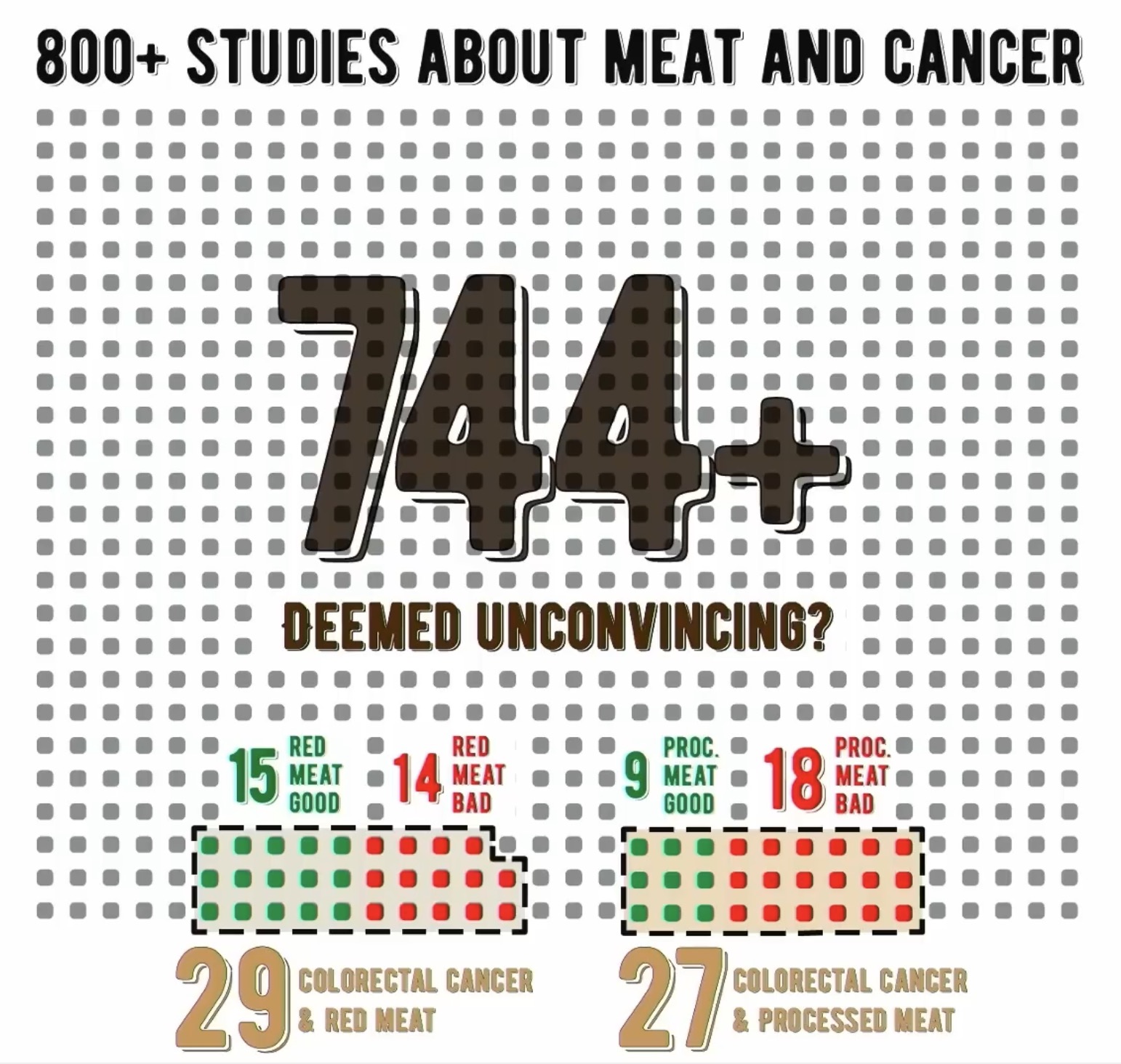
At 1h he makes a really good point; If nutritional epidemiology “science” is so weak that it needs lower standards of evidence then actual science it shouldn’t be called science. It shouldn’t be presented with the same rigor and confidence as empirically demonstrated science.