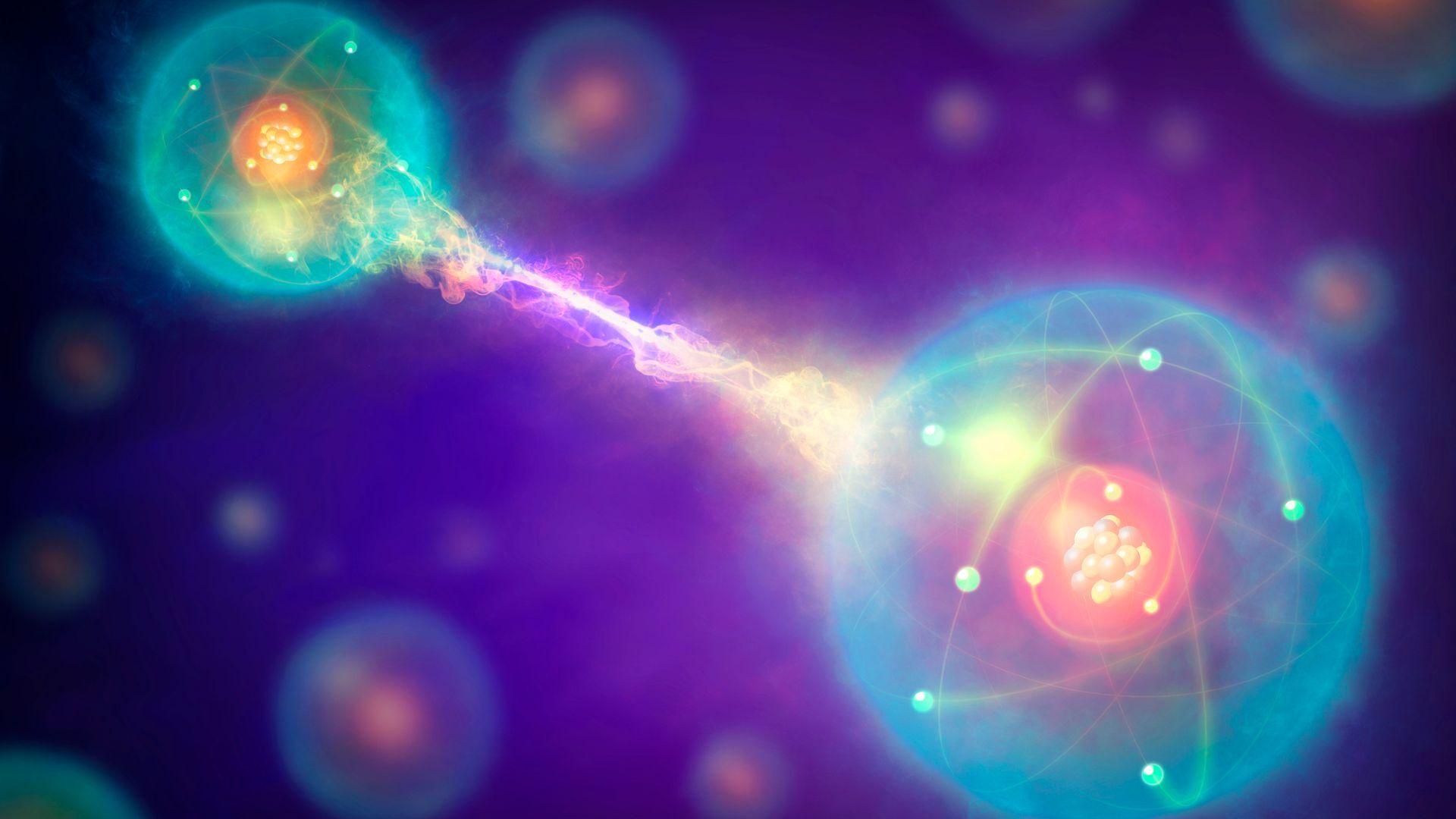
To prove the entanglement was real, the team used a device called a Rarity-Tapster interferometer.
That’s what I was going to suggest.
Sounds like 1950s scifi B movie jargon.
Classic
Doesn’t all physics lingo?
Yeah, actually 🤔. I heard the phrase “quantum magnetometry” not too long ago and it sounded made up as hell, along with the device using it and what it can do (it’s a heartbeat sensor that csn detect a heart beat several kilometers away).
Shit’s real.
(it’s a heartbeat sensor that csn detect a heart beat several kilometers away)
Damn. When the robots take over, we are so fucked.
It’s already pretty scary; it’s a CIA/NSA tool.
Just learn to stop your heart at will. 🤷♂️
Isn’t there no real evidence such a device exists or could even work theoretically?
That’s from the Veritasium video, right? I remember that they mentioned that there isn’t any evidence for such a device and it is likely impossible at such a large distance. Evidence the technology does exist, but only at very short distances in ideal conditions.
The turboencabularor was busy
Quantum entanglement is one of the strangest features of quantum mechanics. When two particles are entangled, a measurement of one instantly affects the other. Scientists had demonstrated this before in photons (packets of light) and in the internal spin states of atoms but never in the motion of particles with mass. This is important because atoms have mass, and mass responds to gravity; photons don’t. Momentum-entangled atoms could one day power quantum sensors precise enough to detect space-time ripples called gravitational waves or to map Earth’s interior.
Wait photons don’t interact with gravity at all? It is just that the warping of spacetime by gravity effects light indirectly?
Photons do have energy (in the stress-energy tensor), so they curve spacetime too, but all particles follow geodesics regardless of mass…so…I guess it is all the same from gravity’s PoV…it is QM that makes a difference…but entanglement doesn’t either (like gravity)…wink wink, nudge nudge…
PS: ok, ok, radiation’s energy density is 1/a⁴ and baryons is 1/a³, so there is a distinction there to having inertia towards gravity.
the actual paper https://www.nature.com/articles/s41467-026-69070-3