

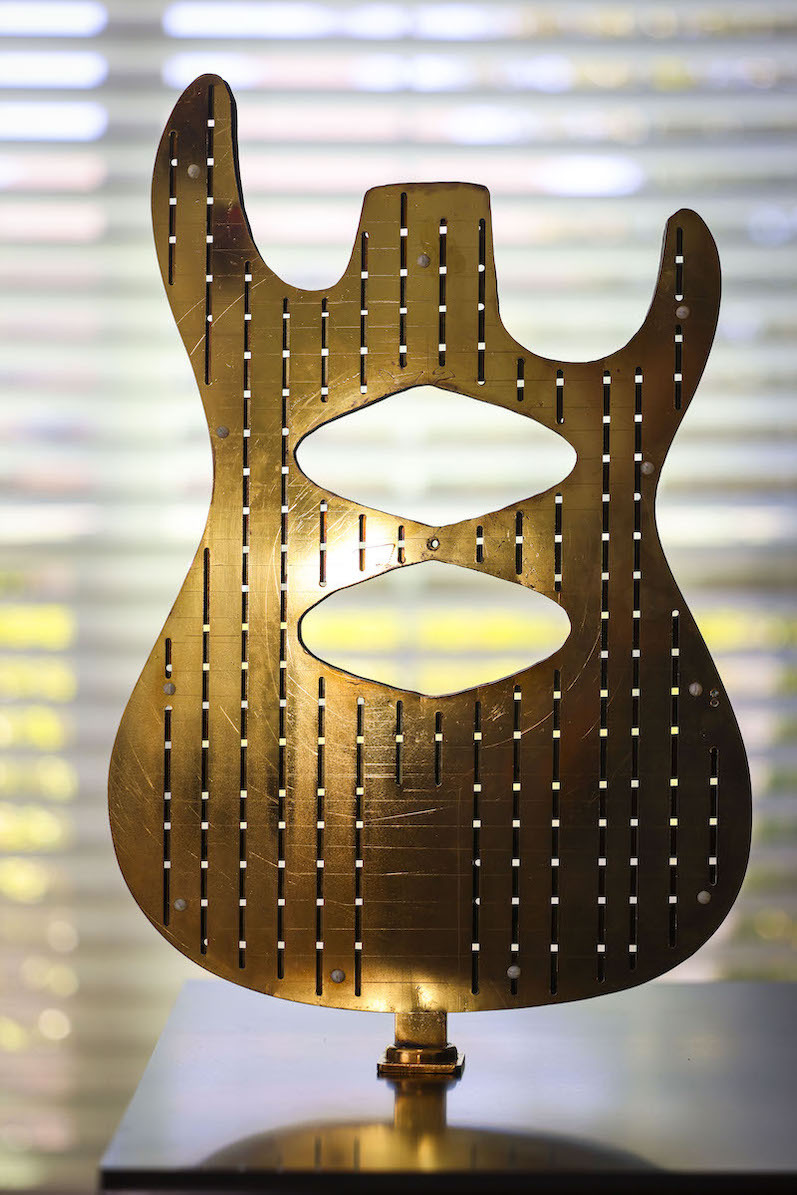
This is the first prototype photonic guitar. A photonic guitar works like an acoustic instrument but instead of the resonance of wood and acoustic vibrations it uses the resonance of electricity and electromagnetic waves (light). I first created this guitar as a design tool for electric guitars before I fully recognized the significance of the underlying physics. It wasn’t just like a guitar, it is a guitar. I suspect some people reading this don’t believe me but that’s ok, neither did my old physics grad school at first. Same with the patent office. I’ve linked an article about me from the Dallas Morning News.
While the photonic guitar produces music it doesn’t produce sounds. The waves it creates are electromagnetic (light). While electric guitars match the same frequency as an acoustic guitar, the photonic guitar matches the same physical wave size. So the 20 Hz - 20 kHz audible range is equivalent to 20 MHz - 20 GHz. We can’t see those waves either. So I created a guitar plugin, a physics based model for the photonic guitar driven by measurements, to recreate and apply the photonic musical effect to electric guitars.
For years I could only wonder what the photonic guitar was going to sound like. From physics I would argue it would have properties of an acoustic guitar. Both systems satisfy the wave equation and have the same boundary conditions. In practice I’m most surprised by the impact it has on distortion, noise, and feed forward. Feed forward is analogous to feedback but doesn’t require holding the guitar up to the amp speaker. That and the fact that the guitar itself can produce a delay effect. I’ve linked to one of my favorite demos so far.
I understand that they’re physics driven, I’m just a little confused as to how that’s translated to audio.
Strumming a guitar string creates vibrations, which are picked up by our ears and translated to audio data (obviously simplified). It’s almost like you’re creating “vibrations” for a type of ear that we don’t have.
It’s like trying to paint with colors that our eyes aren’t capable of seeing/processing; how would you even accurately do that?
So there has to be some form of human interpretation between the vibration data, and the audio (for human ears) that the plug-in spits out. Right? Or is that all determined with the knobs?
Either way, very cool stuff
Thanks!
Yeah, saying I’m creating vibrations for an ear we don’t have, or painting with colors we don’t see, is probably a correct description. The way to accurately explore these types of things is with math/physics and a whole bunch of thinking :)
The connection between the original data and the audio that comes out is based on waves of the same physical size. An acoustic wave at 20 Hz has the same physical wavelength as an EM wave at 20 MHz. Since these waves both have the same size they have equivalent interactions with a guitar the same size, shape, etc.
So I have the plugin output 20 Hz audio for 20 MHz EM waves, and so on. Then I added a knob in the plug-in to allow users to shift that relationship up or down a bit, help musicians dial in the sound they want. So it starts with fundamental physics relationships but I’ve added flexibility where possible for fun.
Very interesting, thanks
Thanks for the questions!