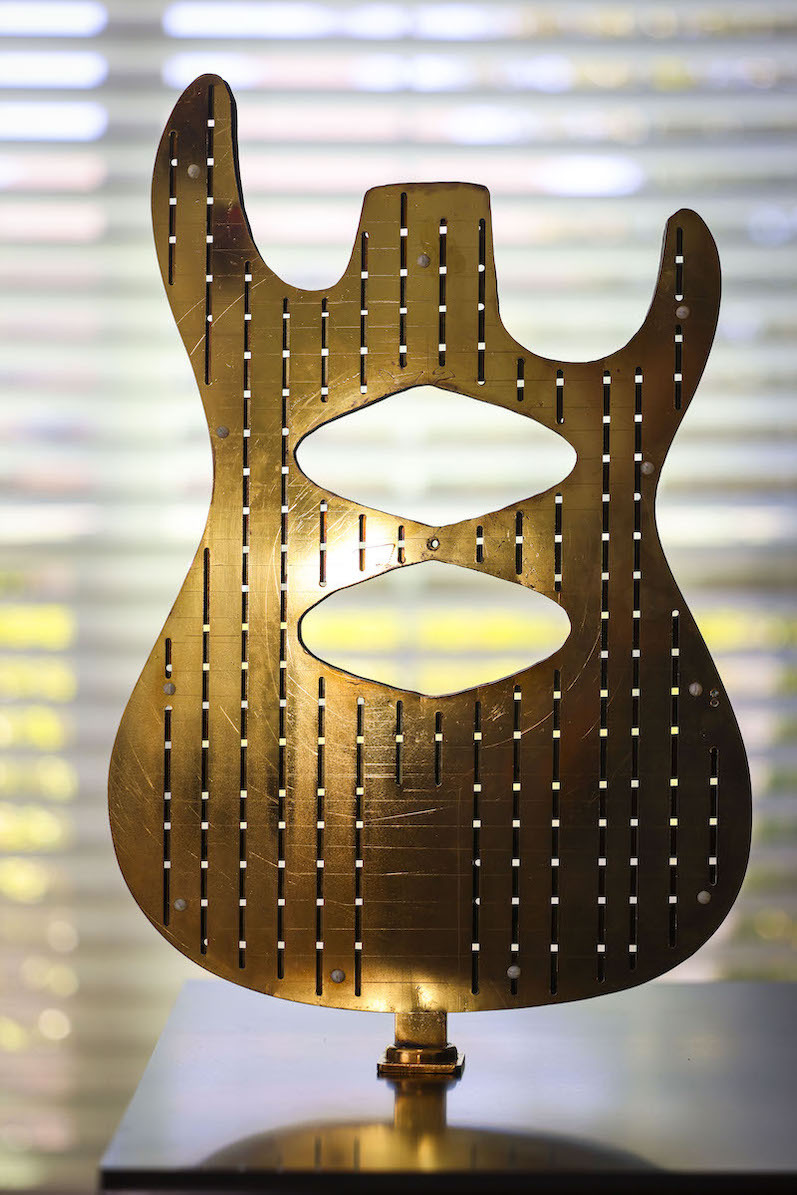
This is the first prototype photonic guitar. A photonic guitar works like an acoustic instrument but instead of the resonance of wood and acoustic vibrations it uses the resonance of electricity and electromagnetic waves (light). I first created this guitar as a design tool for electric guitars before I fully recognized the significance of the underlying physics. It wasn’t just like a guitar, it is a guitar. I suspect some people reading this don’t believe me but that’s ok, neither did my old physics grad school at first. Same with the patent office. I’ve linked an article about me from the Dallas Morning News.
While the photonic guitar produces music it doesn’t produce sounds. The waves it creates are electromagnetic (light). While electric guitars match the same frequency as an acoustic guitar, the photonic guitar matches the same physical wave size. So the 20 Hz - 20 kHz audible range is equivalent to 20 MHz - 20 GHz. We can’t see those waves either. So I created a guitar plugin, a physics based model for the photonic guitar driven by measurements, to recreate and apply the photonic musical effect to electric guitars.
For years I could only wonder what the photonic guitar was going to sound like. From physics I would argue it would have properties of an acoustic guitar. Both systems satisfy the wave equation and have the same boundary conditions. In practice I’m most surprised by the impact it has on distortion, noise, and feed forward. Feed forward is analogous to feedback but doesn’t require holding the guitar up to the amp speaker. That and the fact that the guitar itself can produce a delay effect. I’ve linked to one of my favorite demos so far.
For years I could only wonder what the photonic guitar was going to sound like
Aren’t you kind of the one choosing how it sounds, as you’re the one who created the plug-in to translate it to audio?
Maybe I just don’t understand what the plug-in does.
The plug-in is a physics based model using boundary conditions for electromagnetic waves. The model itself is driven by measurements of the guitar. No measurements, no sounds. So while I did create the software all the details come from physics.
Within the context of the plug-in I hooked up knobs to all kinds of physical parameters, so users can pick those, but the interactions that result are all physics driven.
I understand that they’re physics driven, I’m just a little confused as to how that’s translated to audio.
Strumming a guitar string creates vibrations, which are picked up by our ears and translated to audio data (obviously simplified). It’s almost like you’re creating “vibrations” for a type of ear that we don’t have.
It’s like trying to paint with colors that our eyes aren’t capable of seeing/processing; how would you even accurately do that?
So there has to be some form of human interpretation between the vibration data, and the audio (for human ears) that the plug-in spits out. Right? Or is that all determined with the knobs?
Either way, very cool stuff
Thanks!
Yeah, saying I’m creating vibrations for an ear we don’t have, or painting with colors we don’t see, is probably a correct description. The way to accurately explore these types of things is with math/physics and a whole bunch of thinking :)
The connection between the original data and the audio that comes out is based on waves of the same physical size. An acoustic wave at 20 Hz has the same physical wavelength as an EM wave at 20 MHz. Since these waves both have the same size they have equivalent interactions with a guitar the same size, shape, etc.
So I have the plugin output 20 Hz audio for 20 MHz EM waves, and so on. Then I added a knob in the plug-in to allow users to shift that relationship up or down a bit, help musicians dial in the sound they want. So it starts with fundamental physics relationships but I’ve added flexibility where possible for fun.
Very interesting, thanks
Thanks for the questions!
Are you like, high out of your mind?
Nice looking guitar tho
Ha! Not at the moment. ;) No I just understand physics better than most.
Thanks, I think it looks nice as well.
Looks cool!
It wasn’t just like a guitar, it is a guitar. I suspect some people reading this don’t believe me but that’s ok, neither did my old physics grad school at first. Same with the patent office.
Okay, I’ll bite. What makes this a guitar rather than a synth or other electric music component?
What makes this an instrument even, if you can’t make music using your own body?
Also, would you call a piano a type of guitar? It’s just a bunch of strings tied to a resonating body after all.
Forgot to mention that the size and shape of an acoustic guitar dictates its resonances. The same thing with a photonic guitar. By making a photonic guitar the same size and shape as an acoustic the photonic guitar will resonate at the same wavelengths.
Note I can also make a photonic piano. Ideally we’d use coaxial cables for the strings. Photonic instruments use the resonance of electricity in the same way an acoustic piano uses the mechanical resonance of a string.
I started with a guitar since I’m more guitarist than pianist. Also guitars are cheaper and smaller to construct. Incidentally a photonic piano would be easier to play directly than a photonic guitar since the musician string interaction for the piano is mediated by the keys. Conversion between em waves to audio would still be required though so there will always be tech required.
Cool!
By making a photonic guitar the same size and shape as an acoustic the photonic guitar will resonate at the same wavelengths.
Are these resonances in the guitar body itself, or in electric wires inside the body, or some third thing? Would changing the shape of the body necessarily change the resonant frequencies, or is it only certain parts of the body that are involved in that?
The resonances are in the guitar body itself. Either in the metal plates, directly as electric current, or via electromagnetic waves in the guitar cavity.
Changing the shape will change the resonant frequencies.
So the photonic guitar is an acoustic like instrument that uses the resonance of a physical field that we wouldn’t normally have access to. The photonic guitar can be played similar to an acoustic we just aren’t well suited to direct play. The timescale is a million times faster plus we can’t hear the music that is created. The photonic guitar differs from other electronic equipment as electrical instruments make waves at acoustic frequencies (20 Hz - 20 kHz) while the photonic guitar operates in a range a million times higher (20 MHz - 20 GHz) which physically allows for resonant waves in a guitar sized body.
I call this a guitar because it is guitar shaped, and not shaped like a piano.
Interesting.
The photonic guitar can be played similar to an acoustic
How would this be done in theory?
The photonic guitar differs from other electronic equipment as electrical instruments make waves at acoustic frequencies (20 Hz - 20 kHz) while the photonic guitar operates in a range a million times higher (20 MHz - 20 GHz) which physically allows for resonant waves in a guitar sized body.
We also find that kind of resonances other places, e.g. radio antennae or the optical cavities of lasers. Are those also a type of photonic guitar? Or maybe photonic strings?
I call this a guitar because it is guitar shaped, and not shaped like a piano.
Haha, makes sense. Would it be a flute if it was flute shaped?
In theory the photonic guitar would be played like an acoustic. The strings would be a coaxial cable. To excite a resonance we’d need to apply an electrical impulse to the ‘string’, like by using a charged guitar pick. We’d get different notes by changing the effective length of the coax cable. We could probably do this with a standard guitar neck but we’d need to electrically ground the frets. The biggest hurdle is simply that the music for a photonic guitar is a million times faster. Requires a ton of scale practice for speed ;)
I’d say the antenna and laser cavity would be closer to a string.
Yep, if we made a flute shaped photonic instrument it’s response would be flute like.
Can you describe how one physically ‘plays’ this instrument? Or better yet, upload a video of someone doing so?
For example, one plays a guitar (or any stringed instrument) by vibrating a string at different lengths to achieve different pitches. Most instruments’ bodies are hollow to provide a natural resonator so we can hear it. Electric variants don’t have to follow this, since the vibrations are picked up by magnets and amplified externally, although the vibration of a solid body stringed instrument still counts for a ton of the tone and sustain.
What is the equivalent description of your instrument? Where does one put ones hands to play it, and how is the sound produced?
The equivalent string for a photonic guitar is a wire, or coaxial cable. Different lengths of the cables would produce different pitches. Rather than a mechanical vibration it is electrical. The photonic guitar body is also hollow and would resonate electrically like an acoustic. The photonic guitar doesn’t make sounds though. The waves are electromagnetic. Because of the different physics the photonic guitar has to be played a million times faster than standard. So in practice the photonic guitar is easiest to play using technology, more like a guitar pedal. It is possible to create more direct ways to play the instrument but that requires kore resources to develop. I hope to pursue those though if and when the current plugin is successful in the market.
OK so when you are uploading demos of your device, are you simply sending a previous recording of a normal guitar through it? Or if not how does a musician ‘play’ the instrument to produce these sounds?
We use an electric guitar recording that runs through a photonic guitar plugin that runs on iOS. Can also be played live of course.
This sounds incredible. It reminds me of Chuck Salamone’s style of playing in the Hylics games. Are you planning on producing these?
Thank you. Yeah, I hope to produce more in the future. Different shapes and different metals will have different sounds.