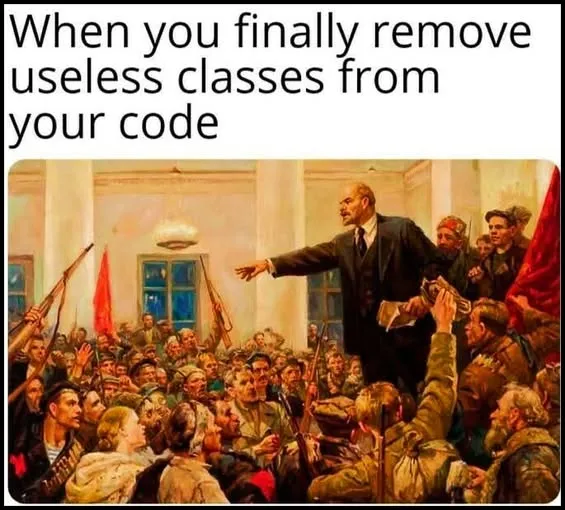
replaces Classes with Functions
code is still parsed from the top down and some functions are more privileged than others
It’s just like Lenin wanted!
The Comintern has reviewed this comment and found it quite funny
Sometimes I still see job postings that are like “MUST KNOW OBJECT ORIENTED PROGRAMMING” and I’m wondering who in 2026 isn’t at least passably familiar with it.
But then again I also see job posts that are like “must know Java or JavaScript”
Considering most people only know procedural programming and are calling it functional/objective…
A lot of those posts will also include shit like must know XML and AJAX and it’s clear the recruitment division hadn’t updated their template in ages.
There’s a lot of legacy stuff around. I saw some CORBA in the wild recently.
What is not clear is if the software development division updated their practices.
Exactly, if there’s even the slightest risk that I’ll need to dust off the good ol ajax that’s a nope from me.
in 2026 you really have to ask an employer what they mean by object oriented programming in the interview. do they mean a methodology of organizing pure functional code into actors and message busses? do they mean imperitive code that’s interacted with through generic interfaces as with python? or do they mean javascipt style OOP where you define classes to organize your imperitive code within a functional language without any concern for the generic interfaces this could hypothetically enable?
Object.property = theft;
sieze(worker, ObjectFactory.meansOfProduction);
Seize the means of prod!
Or just prod! Seize prod
Deploy broken code straight to prod?
Testing is for those who are not confident in their programming skills.
testing is doubting
Or do as Alan Kay wants and start calling it “Message-Oriented Programming”.
“I’m sorry that I long ago coined the term “objects” for this topic because it gets many people to focus on the lesser idea. The big idea is “messaging”.”
https://lists.squeakfoundation.org/pipermail/squeak-dev/1998-October/017019.html
I skimmed that.
So you’ve got a bunch of message transceivers (aka objects). And the magic is in the message soup.
Yes?
From my understanding, yes. Personally, I’ve seen so many different definitions of “OOP” (most of which were incoherent), I developed my own definition of what an ‘object’ is, and just go on with life.
I still get sad when I think about Objective C and how it didn’t take off vs C++ just because it had ugly syntax (which becomes beautiful once you understand why it is the way it is)
I’m still mad at Apple for making Swift instead of Objective-C 3.0. It was such a powerful and small language.
C++ has a billion features and Swift is getting more every year.
Objective-C was fast to compile, great in a debugger, and allowed lots of creativity and patching broken system components.
Lots of great software was written with it. CocoaBindings are magical.
Why is it the way it is?
Both C++ and Objective-C aimed to be “C with classes”. C++ does it by hijacking existing syntax (struct), Objective-C does it by adding new syntax, while leaving the original minimalism of C untouched.
In fact, it’s a strict superset of C, which means it doesn’t change anything at all in C, it only appends. So every valid C program is a valid Objective C program (which is not true for C++).
You know how some C programs are valid C++ programs though? Well, those same programs can use Objective C features too, meaning you’re able to use them in C++… Meaning you’re able to code in “Objective C++” (which is very common for interop purposes)
Fuck OOP all my homies use DOD.
Department of defense?
It’s DoW now, baby. And apparently, it’s over 50,000!
And then the code has removed your whole database.
This but unironically