
You must log in or # to comment.
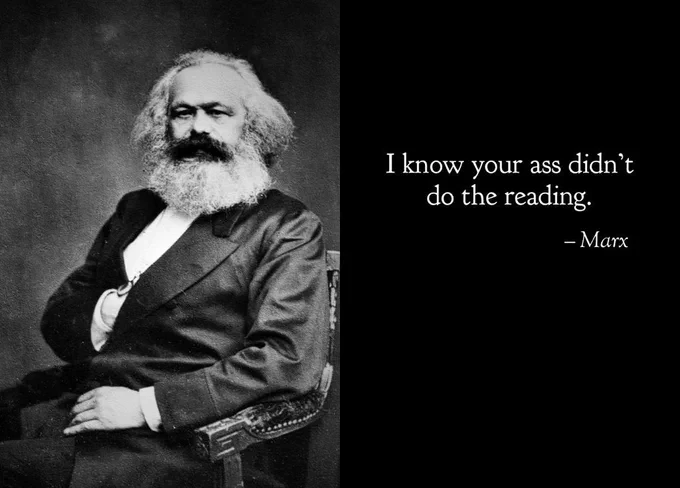
I almost forgot that we’re not allowed to do or think anything without first running it past a Beardy McDeadguy that hasn’t been around for almost a hundred years.
You must read the originator to practice something. You aren’t a real capitalist if you haven’t read Adam Smith and you aren’t a real sadist if you haven’t read the 120 days of Sodom. /s
Fr though, theory is great and more people should read it, but also we must burn our bookshelves to be free as it were. Theory is just ideas, both vital to our ability to imagine and build a better world, but ultimately something that should be willing to build on, challenge, and eventually make even the most important thinkers academic.
So yeah read Marx, Proudhon, Kropotkin, Stirner, Goldman, Lenin, Mao, Huey Newton, Angela Davis, Graeber… but not like how a Christian would read the Bible. Read them as one reads philosophers (and a biologist and anthropologist who also did philosophy). Read them critically and see what they got right, ask what they might have gotten wrong and why. Ask what you can learn from their ideas and the effects of different people’s approaches to building on their ideas. When we treat them as secular prophets we do a disservice to them, ourselves, and those who will come after us.
Also like, do more than just read them. You actually have to try to meet people where they are. Talk about the ideas in ways that people are receptive to then eventually drop in where you got them. Convince ordinary people about this stuff as you organize to make more of it happen. Not through smugness but by sympathizing with their actual problems and building a dialog. Practice what you preach, both because it enhances credibility and is the right thing to do, but also because what we on the left preach is difficult to do and we need the practice.
I did buy the book tho… it’s with all the other books… I’ll read them at some point…
Most leftist books are complicated and boring, this one is simpler and more engaging. Maybe give it a try before tackling the dry tomes.
Berkman’s work explains anarchist philosophy in terms that uninitiated readers can understand. The book’s chapters are brief, and many of them begin with questions (e.g., “Is Anarchism Violence?”, “Will Communist Anarchism Work?”). A number of the ideas he discusses are similar to those proposed in The Conquest of Bread by Peter Kropotkin, whom Berkman cites throughout. Berkman avoids the sort of jargon and technical language that is often used by political writers in favour of plain language. As he writes in his foreword:
Anarchist books, with few exceptions, are not accessible to the understanding of the average reader. It is the common failing of most works dealing with social questions that they are written on the assumption that the reader is already familiar to a considerable extent with the subject, which is generally not the case at all. As a result there are very few books treating of social problems in a sufficiently simple and intelligible manner. For the above reason I consider a restatement of the Anarchist position very much needed at this time—a restatement in the plainest and clearest terms which can be understood by every one. That is, an ABC of Anarchism.[11]
https://en.wikipedia.org/wiki/Now_and_After
Available to read for free, here.
Nobody should ever be challenged
Incorrect enterpretation. If you want someone to take on great challenges, they must first manage small ones well, lest they fail and give up.
The book above is still somewhat long and challenging, but is more surmountable. It may yet open the door for some to tackle the heavier, dryer works.
Is this the first thing they have ever read?
Do you want to feel superior or do you want to increase access to your ideas? Most people won’t read a dense tome or even a particularly difficult book of something they’re mildly interested in. It goes even more for something other people tell them to read in ways very reminiscent of people saying to read the bible.
Meet people where they are, and as you convince them that there’s some merit to your ideas you can challenge them with challenging ideas. Some of those people will move on to difficult books, others however won’t because they prefer other types of challenges. In order to get what we want we need a lot more people on our side and that means addressing how bad we are at spreading our ideas to the general masses.
If communism means reading books that are long, difficult, and boring to ordinary people, most people don’t want it. They don’t read their bibles when they’re Christian and they won’t read their Marx if they’re communists.
do you want to feel superior
Almost alwaya. Not that anyone ever ASKED my consent.
do you want to increase access to your ideas
More often than not.
dense tome
The kinds of people who will actually read any sort of book probably like to either challenge themselves or want knowledge presented efficiently, if they don’t just want a good grade in communism. All of those would motivate you to read something a little more exciting than ‘good things good sometimes bad things bad sometimes: the book’. Challenge is not insult, fight me bitch.
They want knowledge presented efficiently, yes, and presenting knowledge efficiently means speaking to people in language that doesn’t get in the way of the ideas to those who are new to them. Academic language is a skill. That skill shouldn’t be presented as a barrier to learning about how the working class deserves more. Hell you can recommend people read theory that does speak to them in more common language. The Black Panthers were really good at speaking to people where they were. David Graeber also was excellent at it.
But why do people read any given text? Because they’ve been given a reason to want to. A podcaster got me started on my recent Graeber binge, and I excited by and enjoying the books convinced some friends to add one to their lists, as well as me talking about what I liked about and found fascinating in these books here on lemmy. Now I’m in the middle of some fiction unrelated to all of it because those friends recommended it to me.
“Go read theory” is brushing people off and cannot be expected to produce the result of them actually reading anything. “Hey, I’m not really doing my position justice in this discussion, if you’d like a much better argument read X by Y, it’s where I got a lot of these ideas, I found it really illuminating” is a much more effective means of getting someone to read.
There are plenty of challenging books to read. I don’t know many people who read books because they know they’ll be challenging, especially as throughout this discussion challenging has both meant “ideas that challenge one’s views and reshape them” and “ideas presented in a way that is challenging”.
The former is generally positive. Many people can enjoy such things whether it’s in a book (ideal as it can go into a level of depth other media struggle with, but also is the least easy to get people on board with because of the time investment), a discussion with someone they’re comfortable listening to, a zine, a podcast, or whatever else. Hell LeGuinn was great at using fiction for it.
The latter meaning of challenging however has upsides and downsides. It may add precision and complexity at the cost of legibility. When legibility is lost many walk away. It takes more effort to get to the dang ideas in the first place. This is especially the case with academic language, which many aren’t familiar and comfortable with.
Presenting old ideas in a newer and easier to access way is good. It’s a role that on the left spent far too long as the domain of zines and not much else.
When people feel they’re supposed to read a book because it’s important they put it off indefinitely. Reading it can feel like homework. If you want people to understand theory you need to help get everything but the ideas out of the way of the ideas and get them interested in knowing more. When they want more then you can spring a book with a painfully 19th century academic title on them, then they may actually read it.
My brother in Christ, you didn’t put and cool pictures on the books.
That’s why I have the kickflip-gibson function included in most of my publications. It notes the correlations (usually positive) between coolness l the quantity of kickflips, and quality of the air guitar solos you have during said kickflip. And the graph looks like Howard the Duck’s duck girlfriend’s bobs.