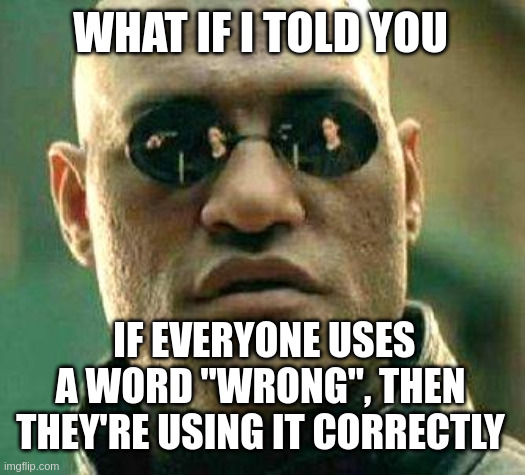
Ok ok… I’ll be the one…
“Wrongly”
no worries I’ll use it the wrongliest
You can always go wrongliester!
I’ll use it righteously.
I’m gonna use it wrongteously
not not-heinous
Good wrongliesterness.
He wrongly assumed he was using the word wrongly.
Very bigly, indeed!
Incidentally, I really hate that the UK expression for when someone is feeling sick is “poorly”.
It’s got the “ly” ending which is one of the clear signs of an adverb, and in other contexts it is used as an adverb. But, for some reason the British have turned it into an adjective meaning sick. Sometimes they use it in a way where it can be seen as an adverb: “He’s feeling poorly”, in which case it seems to be modifying “feeling”. In the North American dialect you could substitute the adjective “sick”: “He’s feeling sick”. But, other times they say “She won’t be coming in today, she’s poorly”. What is the adverb modifying there, “is”?
Washing-up fluid.
Washing up what?
Dishes?
Dishwasher fluid.
Why fluid, not liquid? Air is a fluid too. Is it in gaseous form?
Also, why “washing-up”? Was “washing” not enough? Was a direction strictly necessary?
Plasma?
Think different
Some flat adverbs sound perfectly natural to most speakers, like “play nice” or “drive safe”. Others have less acceptability among people in general, like “That tastes real good.”
Tastes real goodly.
I don’t even see “nice” in “play nice” as an adverb. You could switch “play” for “be” – “be nice”, same with “be safe”.
There’s that old line that if my aunt had wheels she’d be a bicycle. Maybe the command form is muddling the topic here, but using the be-verb with an adjective like that attaches a subject complement, essentially describing the subject. But “I am fast” describing a person doesn’t mean that saying “I drive fast” is describing a drive as a noun.
Playly not nice.
I’m gonna get the shit downvoted out of me for this, but the problem with this idea is that insular communities tend to redefine words and then expect everyone outside their bubble to know their new definition. Doing so also robs the language of a word that served a specific purpose, such as in the case of the word “literally.”
And then the speakers from insular communities get told to fuck off with their special definitions, or they’re so persistent that the new definition catches on. Either way, problem solved.
The word “literally” still serves its old purpose just fine, along with the new one.
My issue with “literally” is that it’s become an actual part of the dictionary definition rather than being recognized as merely a hyperbolic use of the word.
Dictionaries are books of history, not law.
Language pedantry is a branch of theology.
Those two sentences are not mutually exclusive.
But every word can be used hyperbolically.
no, it can’t. hyperbole means to exaggerate, to a great degree. descriptors like “round” or “soft” can’t be hyperbolic.
Calling fat people round is hyperbole isn’t it?
Or calling a bald guy “Curly”
no, it’s either true or false, but even a false usage isn’t hyperbolic, it’s just wrong
It really depends on how they are built. I have deffo seen some rounder obese people.
Dictionaries can also note hyperbolic (and other “deformed”) uses of words, especially when commonplace, I see no problem with that. You have some odd expectations from dictionaries.
A dictionary is a record.
Language influences the dictionary, the dictionary doesn’t influence language.
Did that literally happen?
Or has actual fallen foul of another meaning change too now?
It’s a definition in Merriam-Webster as of several years ago.
My pet example is Americans and “ironically/unironically”.
Please don’t do this to me
Didn’t english literally develop in an insular community (britain)?
English is what you get when a community can’t defend its borders and keeps being taken over by new rulers with a different language, which then works its way partly into common usage. Also, random word borrowing, because fuck you it’s ours now.
Not insular enough to be isolated, hence that saying about it being three languages in a trenchcoat.
Of course not isolated, but insular, literally.
There were a lot more langauges on those isles long before and during the [still ongoing] development of english, and during the empire connecting to more of the world more than any other in history… so, not so insular during its development.
Literally.

I literally love and hate this comment.
Lol, I came here to make this exact comment
That’s dumb (which originally meant “mute” or “unable to speak”)
This is real and actually quite interesting to look at the history of. For example, the word “Decimate” IIRC was originally defined as killing one for every ten people of a group of people. Now, its used as a term for high impact destruction.
My usual example is manufacture — to make by hand, but it’s more commonly used now to mean machine manufactured and made by hand is called handmade.
That’s a good one. In school they had me memorize a novel of Latin root words, which is where things can get frustrating. You take a word and piece together the meaning, only to find out the definition has changed so drastically over the years that the root words are now nonsense. Both of our examples fit this description.
Yeah, I’m prone to go down rabbit holes looking at the etymology and origin of related words for hours. Latin was one of my favorite classes in high school. It’s great for world building and stylizing prose when writing fiction.
Sometimes the etymology is just weird because the current meaning is from an abbreviation of a phrase and the roots don’t make sense in isolation, such as perfidious, from the roots per fidem “through faith” but its meaning is from the larger phrase “deceiving through faith.”
Mine is electrocuted which means to die or get executed by electricity but people say “the person got electrocuted and is recovering in the hospital”.
I mean, I’d still call 1 out of 10 people dying “high impact.”
You are technically correct, the best kind of correct.
It was originally killing 1 in every 10 by lot. In other words, not in battle, but as a collective punishment of a unit 1 in 10 soldiers would be randomly selected and killed.
1 in 10 soldiers dying in a battle doesn’t sound all that bad. But, 1 in 10 soldiers being selected to be killed as a form of punishment for the unit sounds a lot worse.
IIRC the other nine had to kill them, by beating with sticks? which makes it so much worse. Rarely used in extremis I believe.
Yay, pseudoliteracy wins. Again. 🤢
Well. Sort of.
Some terminology is better defined by how the relevant experts use it. It’s singular and precise definition is required for any useful dialogue. If 99% of people call a kidney a liver but doctors call it a kidney its a kidney.
Some terminology evolves and is used differently by different groups. Sometimes the more illiterate group flattens the language by removing nuance or even entirely removing a concept from a language with no replacement. Arguably both definitions may be common usage but one is worse and using it means you are.
But do you mean literally everyone or literally everyone?
If it is not literally everyone, it still might be correct in the way that using a word for (one of) its jargon meaning(s) is correct. So, correct in context.
When using words to convey information to an audience to whom you might not be able to clarify, it is useful to use words for the meanings listed in common dictionar(y/ies) (“correctly”) so that the audience can resolve confusions through those dictionaries.
My two are Literally, and Crescendo. I really hate it when they are used wrong, and now the wrong answers are considered acceptable. That means Literally actually holds no meaning at all, and by changing the definition of Crescendo, the last 500 years of Western Music Theory have been changed by people who have no understanding of music at all.
I was not aware of the crescendo one and looked it up. Imagine my surprise learning this dates back at least 100 years ago with the Great Gatsby (have not read it). I am now irrationaly angry that I’m learning about this way too late to complain about it.
Literally being used in the absurdist manner also dates back to the 1800s
I knew that and wasn’t irrationally angry at this one. A hyperbolic or absurd meaning does not bother me (but I get that its “overuse”, for a while, could).
How does someone use crescendo wrong?
Apparently, to mean the climax rather than the increase leading to it.
It’s supposed to mean an increase in volume, but instead it now means a climax. Saying something will “rise to a crescendo” is a popular saying, I’ve seen many good writers say it, but it is wrong. The rising part IS the Crescendo, and the proper way to say it would be that something “crescendoed to a climax.” It is a specific musical term, with a specific musical meaning, and non-musical people have adopted it improperly.
Civilians can’t just come in and start stealing jargon words and apply their own non-jargon meanings. We rely on those meanings to communicate in that world. It would be like suddenly calling a tire iron a stethoscope, and not understanding why a doctor would think that’s stupid.
Civilians can’t just come in and start stealing jargon words and apply their own non-jargon meanings.
This is (literally) one of the more insane takes I’ve ever seen about language. You want jargon to apply only as jargon meaning in all contexts? Lay usage aside, what about when two fields of study use the same word? Battle royale to see who gets to keep it?
Obviously you look into the literature to see who has the first claim, and they get to keep it. The others have to edit and re-print the entirety of the corpus.
Sounds reasonable to me.
There is certain language that is technical to specific things.
A writer wants to borrow language from other worlds to add spice to their writing, so perhaps they borrow a musical term because they think it will describe an action with a special flair. He basically knows that the word Crescendo is a word that somehow relates to intensity, although he’s not exactly sure of the nuance of it, but it has a really musical sound, and will add some nice flavor to his sentence. So he writes about something “rising to a crescendo” and every person who ever had band as a kid, or took piano lessons, etc. CRINGES.
It’s not just about shifting language, it’s about writers not offending their readers with imprecise, poorly chosen words. A writer should strive to choose the absolute correct word, with the exact nuance, and using Crescendo in place of Climax is an egregious example of a poor, imprecise choice that compromised the narrative, and worse, makes the reader question the writer’s competency.
Truman Capote once sat at a bar with another writer, who said “I’ve spent all day working on one page,” and Capote said “I spent all day working on one word.”
That’s because he wanted to choose the exact word, with the precise nuance, to tell his story. I believe that Capote would agree with me about Crescendo.
A writer once put the letter ‘s’ in ‘eiland’ in order to make the word look more Latin. This, despite the fact that the word ‘island’ has no Latin roots. It caught on and now that is the proper spelling of ‘island’ and you’d be a fool to try to force people to spell it ‘eiland’.
English is used by the unwashed masses and trying to get it to adhear to strict rules or not change will be as effective as trying to stop a flood by holding out your hand.
English was not exactly right when you were born with the spelling of ‘island’ and was wrong hundreds of years ago with ‘eiland’, nor is it wrong that dumb means stupid instead of mute, or literally can be used to mean figuratively.
Gif þū ne sacast for eftcyme to Eald Englisc, þonne is hit līcnessēocnes tō sacanne þæt sprǣc ne mæg wrixlan.
I sure hope you say pizzas are disk-shaped, not circle-shaped.
Disk and circle are properly defined geometric terms. Civilians can’t just come in and start misusing them.
To be fair maybe you do make the difference between disks and circles, but the point is, you (and everyone) almost certainly “abuse” some other language element that will also annoy somebody else. And if they corrected you, when all your life you and people around you had done the same abuse and understood each other perfectly, you’d think, rightly, that they are being pedantic.
Do you mean Disk, or Disc?
Both spellings are accepted to designate the mathematical object. I think it’s mostly a UK vs US spelling but please don’t quote me on that.
EDIT just realised I missed the opportunity to answer with the extremely unhelpful mathematician response: “yes”
Look it up, it’s actually fairly complicated, depending on whether you are talking about storage media, vertebrae, Frisbees, etc. and then there is a layer of US vs UK that gets involved.
Oh, yeah, and as for the answer about pizzas, they’re Round. I’ve never called one a disk©, or a circle.
is Tire Iron, the same as Tyre Lever?

Looks like a stethoscope to me.
Everyone can do with a language whatever the fuck they want.
Intelligibility is the only rule in a living language.
So go suck your bravura, and prima vista all over your colla voce.
That’s odd
Well yes it is to me too seeing as that abuse was not made, to my knowledge at least, in my native language.
But then I thought, “well if there is a crescendo, unless it goes on forever, there will be a climax”. So I kinda get where the abuse (or misunderstanding, or literary license, or whatever the intent is) comes from. I don’t, personally, agree with it, so won’t use it that way. But whatever I personally think is irrelevant, at least now I am aware someone might mean that. So I guess now, in English at least, it’s been long enough and widespread enough it’s no longer an abuse (colloquially speaking)
The climax one is in the dictionary.
I’m pretty sure this battle was lost a long time ago. No idea why OP thinks it wasn’t.
Literally holds meaning, two meanings principally. They just happen to be opposite. “Literally” could mean either “actually” or “not actually, but similar in a way”, but wouldn’t ever mean “duck”.
“Literally” only holds the opposite meaning when used as a hyperbole.
You should literally literally when a literally flies straight for your face because those feathered fowl can be as aggressive as gooses.
Joke’s on you, I’m having roasted literally for dinner
How do you feel about other words with their own opposite meanings, like dust or sanction? If the meaning isn’t clear it’s almost always because the speaker constructed a sentence poorly, which of course can lead to misunderstandings even when not using contronyms.
Interesting! TIL
Literally was being used as an intensifier in both cases where it was being used to signify the truth of something and in the absurdist manner. So, no, it didn’t lose all meaning. So long as you’re not emphasizing something too absurd to be considered real, the original meaning still holds. And if someone uses the word to emphasize something that could be real, though unlikely, they’ll likely get the appropriate follow-up.
On the Crescendo one, do you also get mad about forte? Cause basically the same thing happened there. And no one will confuse the music term for the colloquial term in either case.
I hadn’t really thought about forte, but now that you mention it, yeah, that one pisses me off, too. Thinking about it, I do avoid using that term.
And Literally is supposed to mean that some thing is truly as described, to differentiate between exaggeration. So when it is used as exaggeration, it causes the sort of confusion that means exactly what the literal meaning is literally supposed to avoid.
Heaven forbid someone use a colloquialism! How will they ever be understood?
(For the sake of clarity I feel I must point out that I do not believe Heaven should, in fact, forbid such a practice. I fear without this clarification my first sentence is impossible to understand.)
You shouldn’t use religious slang in your writing, it offends the Puritans.
“Heaven” originally meant “the visible sky” so this is fine.
That evolution has happened SO many times. Why does “literally” give you fits when “awful” or “terrific” do not? Perhaps because it’s the shift you happen to be living through?
Or maybe those other things shouldn’t have happened, but it’s too late for them. Now we have to save the words that are in danger now.
If a boat is sinking, and I’m saying we have to save those people, would the proper response be “Well, where were you when the Titanic was going down? Why aren’t you all worried about them?”
This guy is trying to mop up the beach every time the tide comes in.
Holy shit, that’s good
It uses figurative language instead of the literal meaning of words so it’s complete nonsense.
Nah, I’m just fighting the battle for Literally and Crescendo. Those are my hills to die on. I can’t save the entire literary world by myself.
Those words are already lost.
Words aren’t “endangered”. There are literally an infinite number of potential words, if we need to reinvent a meaning, we can quite easily(see: synonym). Further, the original meanings still exist. You can still use “awful” to mean “inspiring awe” and you’re correct, you just won’t be understood.
I think “whence” is a near-perfect example. “Whence” means “from what origin”.
The word is used nearly exclusively in the phrase “from whence it came”, or “from (from what origin) it came”
Love it.
“I have to return back to the ATM machine, but I forgot my PIN number.”
And I’m still gonna bitch about it if they’ve reduced the usefulness of a word due to habitual misuse!
For all intensive purposes, the meaning of words matters less than how we use it. Irregardless of how we decimate it’s meaning, so long as we get the point across there is no need to nip it in the butt. Most people could care less.
Honestly, I could care less about this shit.
Do you care a lot or only a little?
I told you, I could care less! It’s a moot point!
But, how much less could you care? Alot less?
Ah, my favourite.

Gets my brain scrambling for what caring less than zero could be.
Negative care…
Turtles.
I literally don’t give a shit
And I don’t want any of your shit.
I grew up on dairy farm and it was one of my chores to shove the shit and then spread that shit nearly everyday. So I’ve had enough shit. I’m so done with that shit and the assholes it came out of. And I don’t need anyone giving me shit anymore either.
So you just keep your shit to yourself.
Cow shit’s not that bad.
Don’t tell me that’s bullshit.
I have walked in that shit, slipped in that shit, I have even fallen in that shit. Cow shit smells and tastes just as bad as the finest Bull shit. And that bullshit is mixed into that cow shit and the two can’t be separated. No matter how hard you try. And I ain’t dealing with any shit anymore for whatever time is left of my life.
But, I do like drinking my Daily Duck Shit. I have a cup of it right now. I love drinking my Daily Duck Shit and I always try to keep it on hand.
****For those that aren’t fairly deep into Chinese Oolong teas, Duck Shit, “Ya Shi Xiang”, is type of Dan-Cong Oolong tea. You can google Duck Shit tea and get at least one origin story. They are fun stories.
Try pig shit.
I can’t tell if you’re using this idiomatic expression in the wrong way on purpose for a great joke, or in an annoying, unaware way. 😅
Its obviously a joke.
But maybe you understood that and your comment is sarcastic as well. So now I am the one being woooshed.
🥸
Is… is your reply sarcastic too? How far does this sarcasm uncertainuum go?

Everyone has to agree tho.
Don’t be one of these dickheads that defines shit their own way then gets upset when nobody agrees with your dumbass. There’s quite a few people like that here on Lemmy and I find them to be the single most annoying type of user on this site.
It’s better to use words correctly, but in ways that call your understanding of the definition into question.
“I hacked into my sister’s facebook when she left it open on her laptop.”
“In an act of philanthropy I gave George the rest of my fries.”
“Mr. Hands died for his passion, a modern day saint.”
“Tiamat is a Bad Dragon.”
Yeah TRVE, making a point of intentionally being dumb usually means you’re an insufferable cvnt
Minor gripe - it’s not right to say that everyone has to agree, but it is sensible to point out that one person has no real basis for having unique meanings for terms and then reacting poorly when others fail to use them.
Every word had an evolution or hard origin, and each stepping stone on those journeys had some first user. By whatever means, some of those new words or new tweaks on existing words caught on and spread.
And sometimes, despite generally widespread acceptance of a change or a new word, some folks will bitterly hold on to the old ways for years or decades until they just die wrong about it.
By whatever means, some of those new words or new tweaks on existing words caught on and spread.
By whatever memes . . .

Can I have some more pixels please
deleted by creator
April I have more pixels please
June I have more pixels please.<- period
I don’t know, june you?
Just June?
Not every month?
Would you mind providing us a few more pixels? Only if it is no trouble o’course.
/j
I’ve allready to rite we’ll, but than my conscious sad, “For get the rules,” so I let my lose ideals led me. I’m two stubborn to accept that I should of staid in school.
Languages are living things. And living things always change. Note the Great English Vowel Change. Even the Norwegian my Grandfather spoke and that I learned from him was virtually a dead language that modern Norwegians stopped using in the 1850s. And the English spoken in the UK is different than the American English I speak. Spanish spoken in Spain isn’t the same as someone from Mexico speaks.
And when conversing with someone, (in the language of your choice), the words you choose to use are defined by the context you use them in. Words can have multiple meanings, but it’s the context and tone clarifies those meanings. Consider all the meanings of the single word ‘fuck’.
But problems start with written words. And many people have poor written communication skills. It can be hard to parse meaning from poorly written words because there is little context and tone that comes through with a typed sentence.
We are all just baying at the moon like any pack. And hoping some understands us.
Written word is a facsimile of a facsimile of what we’re actually communicating. We go from nebulous thoughts, concepts not bound by language, to sounds that roughly convey those concepts, and then to squiggly lines that roughly convey those sounds, and then back up the chain in the other person. Really, it’s a miracle we understand each other at all.
I would say this is not universal. For some, the written word is the native “tongue”, conveying the actual, intended meaning. The written word allows the speaker the opportunity to evaluate and revise their language to match their intent, and the listener the opportunity to re-evaluate previously transmitted thoughts.
The oral variant is dependent on the real-time aptitude of the speaker to articulate their thoughts and message, and for the listener to extract that meaning from the same. For those of us handicapped in these traits, the spoken word is the poor facsimile for actual (written) communication.
There are those constraints around written/spoken word, for sure. I’m more referring to how close it is to the “raw” thought.
We evolved the ability to think. In order to allow our thoughts to reach others, we developed spoken word. In order to allow those spoken words to be passed through time, we developed written word. Each refers back to the previous “layer” of communication.
Even someone who has a speech impediment, for instance, is still using the same written language as someone else in the same culture. And that written language was developed specifically to try and evoke the words someone in the culture speaks.